


As microfluidic systems continue to evolve toward higher integration, lower sample consumption, and greater functional complexity, one persistent engineering challenge remains: how to achieve rapid and efficient fluid mixing within extremely small volumes.
Researchers from the Collins BioMicrosystems Laboratory (CBML) at the University of Melbourne have recently introduced an innovative solution to this problem through the development of a “plug-and-play” volume-minimizing micromixer, fabricated using the BMF microArch® S230 ultra-high-resolution micro 3D printing system.
Their research, titled “A Plug-and-Play Volume Minimizing Micromixer”, was published in the internationally renowned journal Advanced Science, highlighting a new pathway for integrating high-performance passive mixing into next-generation lab-on-a-chip systems.
Rethinking Micromixing for Real-World Microfluidic Integration
The Collins BioMicrosystems Laboratory focuses on the development of microsystems, microfluidic technologies, acoustofluidics, and advanced bioprinting platforms for biomedical research. Their work spans on-chip cell analysis, laboratory automation, and novel microfabrication methodologies aimed at improving the functionality and accessibility of lab-on-a-chip technologies.
According to the research team, the inspiration behind the project originated from a practical bottleneck widely encountered in microfluidics: although many passive micromixer designs can achieve excellent mixing performance, they are often difficult to integrate into existing systems without introducing excessive fabrication complexity, dead volume, or pressure drop.
In biological and chemical assays, where reagents are frequently expensive and available only in limited quantities, minimizing sample loss is critically important. Traditional integrated micromixer architectures often increase internal volume and complicate device fabrication, limiting their practical usability.
To address this challenge, the team sought to create a truly modular, plug-and-play micromixer that could be inserted into existing microfluidic systems rather than permanently fabricated into the chip itself.
The result was a compact split-and-recombine passive micromixer architecture capable of generating arbitrarily large numbers of fluid lamina, significantly shortening diffusion distances and dramatically improving mixing efficiency under laminar flow conditions. Importantly, the design separates the complex mixing structure from the main microfluidic chip, enabling researchers to combine advanced mixing functionality with simpler single-layer microfluidic devices.
The Fabrication Challenge: Complex 3D Microchannels at Multiple Scales
While conceptually elegant, the micromixer introduced extraordinary fabrication challenges. The design required enclosed microchannels approximately 60 μm in diameter, combined with integrated tubing interfaces and insertion features for seamless microfluidic integration. In addition, the internal channels followed complex curvilinear pathways spanning multiple orientations and length scales.
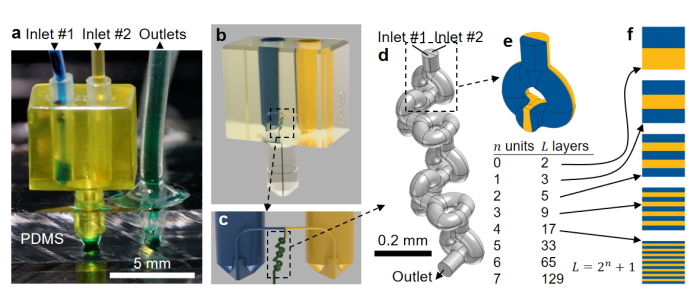
Fig. 1. 3D-printed plug-in SAR micromixer. (a). 3D printed micromixer plugged into a PDMS microfluidic device. (b). Rendering of the mixing device. (c). Close-up view of the fluid path within the micromixer. (d). The micromixer core. (e). Single mixing unit. (f). Theoretical representation of fluid layering as it progresses through n mixing units.
Using conventional microfabrication or molding techniques, manufacturing such a structure would have required multiple aligned and bonded layers. Not only would this significantly increase fabrication complexity and failure risk, but traditional methods would also struggle to achieve true circular channel cross-sections within enclosed geometries.
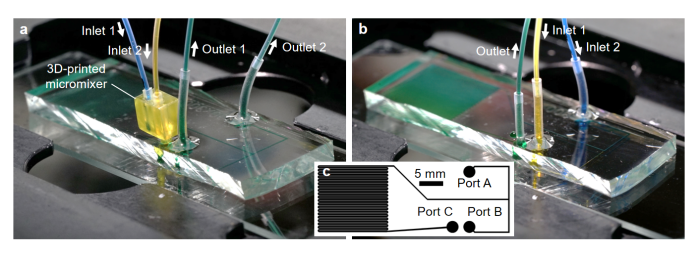
Fig. 2. Experimental validation of the 3D-printed micromixer. (a) PDMS serpentine microfluidic channel layout. (b) 3D-printed micromixer plugged into Port C of the PDMS microfluidic device, Ports A and B serve as outputs. (c) Comparative fluid mixing in the T-mixer, where two fluids are injected through Ports A and B.
For microscale fluidic systems, even minor alignment errors can compromise flow behavior and device performance. The labor-intensive nature of multilayer assembly would have made iterative prototyping both time-consuming and impractical. The research team therefore required a fabrication solution capable of producing highly precise enclosed microchannels within a monolithic 3D architecture.
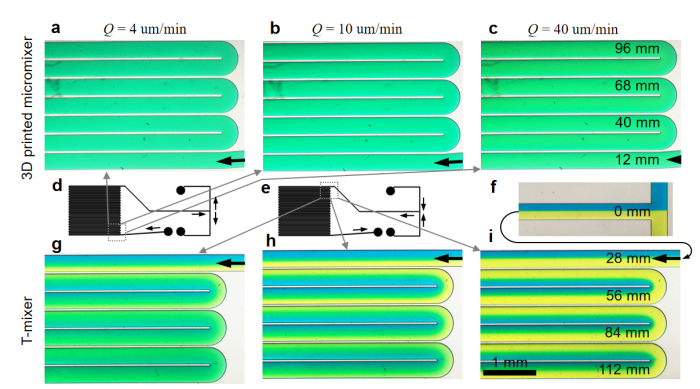
Fig. 3. Mixing tests with coloured fluids: (a)-(c) Fluid flow in the PDMS serpentine microchannel after passing through a 3D-printed micromixer, demonstrating homogeneous mixing at different flow rates. (d), (e) Schematic views indicating the corresponding areas of the microfluidic device for each image. (f) The T-mixer junction where two coloured liquids merge. (g)-(i) T-mixer performance, which is slower and requires a substantially longer serpentine channel to achieve mixing, with performance deteriorating at higher flow rates. (a), (g) Flow rate Q = 4 µL/min; (b), (h) Q = 10 µL/min; (c), (i) Q = 40 µL/min.
Why the BMF microArch® S230 Was Chosen
To overcome these limitations, the University of Melbourne team adopted the BMF microArch® S230 system, featuring an industry-leading 2 μm resolution.
According to the researchers, one of the most important advantages of the S230 was its ability to fabricate extremely small internal channels at arbitrary orientations while simultaneously supporting a larger centimeter-scale device architecture complete with inlet and outlet connections.
Unlike conventional manufacturing approaches, the entire micromixer could be fabricated monolithically in a single print, requiring only the insertion of tubing and direct integration into the microfluidic platform. This capability fundamentally simplified the manufacturing workflow while preserving the intricate internal geometries necessary for efficient passive mixing.
The ultra-high resolution of the S230 proved particularly critical for generating enclosed microscale channels that could subsequently be flushed and utilized reliably for fluidic operation. Surface precision, structural repeatability, and dimensional fidelity were all essential to achieving functional performance.
By enabling the fabrication of highly complex enclosed microfluidic architectures without assembly or bonding steps, the S230 allowed the research team to rapidly move from conceptual design to experimentally validated device.
Unlocking New Possibilities for Advanced Microfluidics
Beyond this published work, the Collins BioMicrosystems Laboratory has already begun utilizing the BMF platform for additional advanced microfluidic applications, including 3D-printed microchannels for impedance spectroscopy systems.
These ongoing projects demonstrate the broader potential of ultra-high-resolution micro 3D printing in enabling next-generation biomedical microsystems, where conventional fabrication technologies often struggle to balance geometric complexity, scalability, and manufacturability.
As microfluidics continues to push toward greater miniaturization and multifunctional integration, fabrication technologies capable of producing precise enclosed microscale geometries will become increasingly essential.
The collaboration between the University of Melbourne, Emlogic, and BMF highlights how ultra-high-resolution additive manufacturing is redefining what is possible in microfluidic engineering, transforming designs that were once impractical into manufacturable and functional research tools.
Local Support Through Emlogic
The project was supported by BMF’s Australian distributor, Emlogic, which assisted the research team during evaluation and device production. Printing support was provided using the S230 system located at Deakin University.
This collaboration helped streamline the transition from design concept to functional prototype, ensuring that the team could fully leverage the capabilities of ultra-high-resolution micro 3D printing for their application.
About BMF
BMF Precision Tech Inc. (BMF) is a leader in advanced micro-scale 3D printing systems. Powered by Projection Micro Stereolithography (PμSL) technology, BMF’s solutions deliver ultra-high precision, resolution, and accuracy for applications in microfluidics, biomedical engineering, precision electronics, photonics, and advanced research.