


Multi-material additive manufacturing is expanding the possibilities of functional product design. Rather than assembling components made from different materials, engineers and researchers can increasingly explore structures in which multiple material properties are integrated directly during fabrication. This approach opens new possibilities for soft robotics, flexible electronics, biomedical devices, and other applications requiring complex geometries and coordinated material performance.
Developed through the collaboration between BMF and Shenzhen MultiMatter Science and Technology Co., Ltd., the microCube® M150 series brings multi-material photopolymer 4D printing to high-precision manufacturing and advanced research.
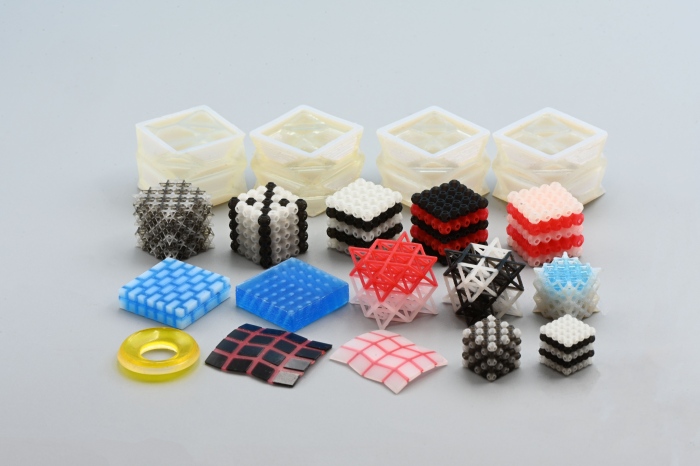
From Three-Dimensional Structures to Stimulus-Responsive Functions
Conventional 3D printing primarily focuses on reproducing a designed geometry. Four-dimensional (4D) printing extends this concept by incorporating materials or structural mechanisms that enable a printed object to change its shape, properties, or behavior in response to external stimuli, such as temperature, light, moisture, or chemical conditions.
Multi-material photopolymer 4D printing provides a manufacturing route for exploring these designs. By selectively combining different photopolymer materials, a single part can incorporate rigid supporting structures, compliant regions, elastic elements, or other functional material combinations.
The microCube® M150 series is designed to support this approach through precision multi-material processing. Its material-switching capabilities allow different materials to be incorporated into a single build, helping users investigate designs that would be difficult to achieve through single-material printing or conventional assembly.
Centrifugal Material Switching: Addressing Residual Material Challenges
One of the technical challenges in multi-material photopolymer printing is managing residual liquid material during material changes. When a printing process switches between materials with different compositions or properties, residual material on the build platform and surrounding surfaces may introduce unwanted mixing, compromise material boundaries, or affect the consistency of the resulting structure.
The system employs centrifugal multi-material switching technology to facilitate the removal of residual liquid during material changes. By integrating centrifugal action into the printing workflow, the system helps reduce residual material and supports more reliable transitions between different materials.
Key Technologies for Multi-Material 4D Printing
Multi-Material Integration with Layer-Level and Intralayer Switching
The systemsupports both interlayer and intralayer multi-material switching, enabling material distribution to be designed across different layers and within the same layer.
Interlayer switching allows different materials to be assigned to successive layers, making it possible to construct structures with distinct functional regions along the build direction. Intralayer switching extends material placement within individual layers, supporting more complex spatial arrangements and the integration of different material properties within a shared plane.
An Open Material System for Application-Driven Development
Material selection is central to multi-material 4D printing. Different applications may require specific combinations of stiffness, elasticity, deformation behavior, or other functional properties. A flexible material system allows users to investigate these combinations according to their research objectives and design requirements.
The system supports materials across a viscosity range of 5–5,000 cps and features an open material system. This provides users with greater flexibility when exploring different photopolymer formulations and developing application-specific material combinations.
Precision Fabrication for Complex Functional Structures
With a 25 μm optical resolution, the microCube® M150 series are designed for high-precision fabrication of intricate multi-material geometries.
In multi-material manufacturing, resolution affects more than the reproduction of external dimensions. It also influences the design of small structural features, the arrangement of material regions, and the implementation of complex geometries in which different materials serve complementary functions.
From Multi-Material Prototyping to Functional Product Development
The value of multi-material 4D printing lies in the integration of geometry, material properties, and function within a single manufacturing workflow. Rather than treating material selection, structural design, and assembly as separate stages, this approach enables them to be considered together from the beginning of the design process.
The microCube® M150 and M150Pro address this opportunity through precision photopolymer fabrication and multi-material processing. For research institutes and industrial R&D teams, these capabilities create opportunities to investigate complex functional structures, evaluate new material combinations, and develop prototypes that integrate multiple mechanical or functional properties.
As multi-material additive manufacturing continues to evolve, the combination of precision fabrication, flexible material selection, and integrated structural design will be important for moving from isolated prototypes toward more sophisticated functional components.
Explore how high-precision multi-material photopolymer printing can support your next research or product development project. Contact BMF to learn more about the microCube® M150 series, material compatibility, and application development opportunities.