


Precise control over liquid movement at the microscale is fundamental to the development of advanced microfluidic systems. From passive liquid transport and selective fluid routing to oil–water separation, conventional approaches often rely on external pumps, pressure gradients, or complex surface treatments. Micro 3D printing provides another pathway by enabling precisely engineered three-dimensional geometries to directly regulate interfacial forces, wettability, capillary pressure, and liquid–solid interactions. By translating biological structures and physical principles into programmable microarchitectures, PμSL based 3D printing is opening new possibilities for passive and selective liquid manipulation.
Recent research has demonstrated how BMF micro 3D printing technology can be used to fabricate intricate fluidic structures that convert geometry into a functional mechanism for liquid transport.
01 | Arch-Shaped Microstructures for Selective Fluid Steering
Full paper:https://doi.org/10.1016/j.cej.2025.168916
Inspired by the high-curvature edge of the pitcher plant, a research team led by Associate Professor Hui Zhang at Xi'an Jiaotong University investigated how curved microstructures can selectively regulate liquid spreading. Published in Chemical Engineering Journal, the study established an energy-based framework to describe the interaction between liquid interfaces and arch-shaped high-curvature edges. The researchers demonstrated that these geometries can generate a significant spreading barrier at the three-phase contact line, allowing liquids with different wetting characteristics to follow different pathways.
To experimentally reproduce these complex geometries, the team employed BMF's PμSL 3D printing system to fabricate microchannels incorporating double-sided arch-shaped edges. The ability to reproduce curved structures with controlled dimensions at the microscale was critical to translating the theoretical design into functional microfluidic components. By varying the ethanol/water composition and therefore the liquid contact angle, the researchers demonstrated selective bidirectional fluid steering within the printed channels.
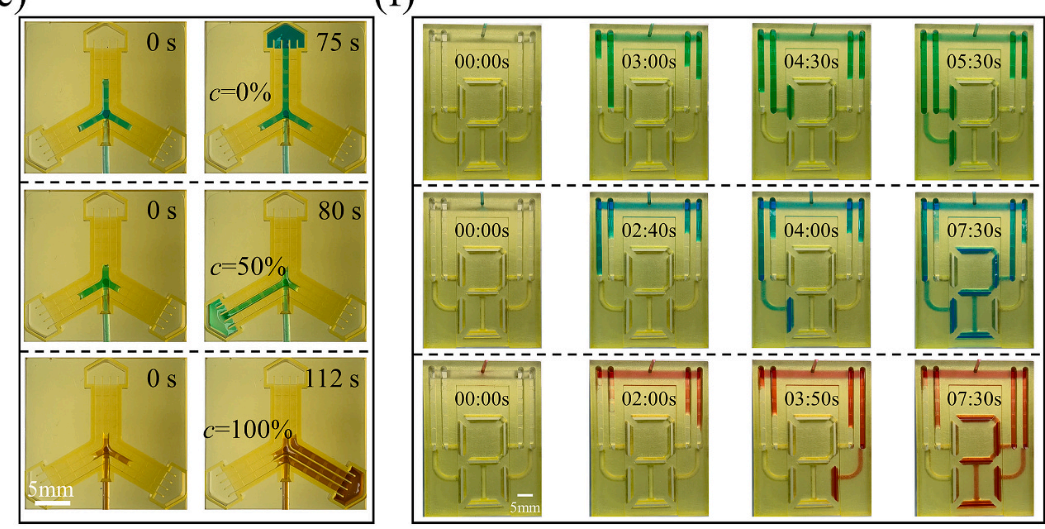
Fig.Functional microfluidic devices based on high-curvature arc-shaped edges
The resulting geometry-driven mechanism was further extended to functional microfluidic devices, including selective Y-branch channels, a fluidic digital display, and an oil–water separator. The study reported approximately 98% oil–water separation efficiency within minutes without external actuation. This work demonstrates how precisely fabricated three-dimensional curvature can serve as a passive “fluidic gate” enabling liquids to be routed, screened, or separated according to their interfacial properties. It also highlights the potential of micro-3D printing to transform theoretically designed surface geometries into practical microfluidic architectures.
02 | Curvature-Ratchet Surfaces for Programmable Liquid Transport
Full paper:https://doi.org/10.1021/acsnano.4c18229
At the University of Hong Kong, a team led by Professor Alan C. H. Tsang explored a different approach to directional liquid manipulation using curvature-ratchet surfaces. Published in ACS Nano, the study investigated how structural curvature, surface tilt, liquid surface tension, and solid–liquid interfacial energy interact to determine liquid transport behavior.
The structured surfaces were fabricated using BMF's microArch® S240(optical resolution:10 μm). The precisely defined curvature and tilted features enabled the researchers to experimentally examine how asymmetric Laplace pressure can be generated and controlled at a three-dimensional liquid interface. Rather than relying solely on chemical gradients or external forces, the surface geometry itself becomes an active element in directing liquid movement.
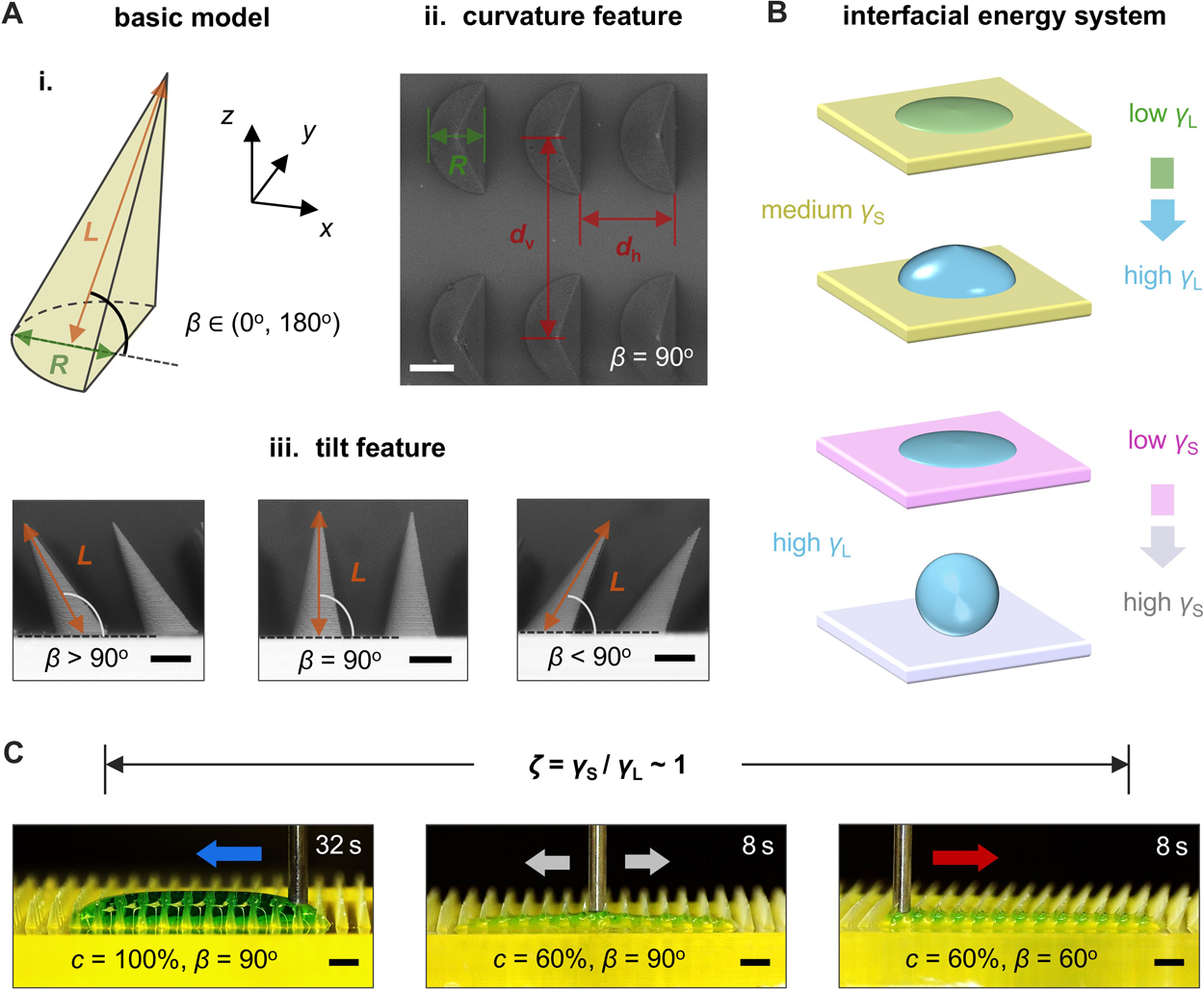
Fig.Overview of 3d printed curved ratchet surfaces and intelligent directional liquid manipulation
The study introduced a dimensionless parameter-ζ, to characterize the relationship between solid surface free energy and liquid surface tension. Around the balanced regime of ζ ≈ 1, the curvature-ratchet surfaces supported a range of liquid behaviors, including directional spreading, redirection, bidirectional transport, and reverse movement. This finding suggests that the same microstructured surface does not necessarily produce a single fixed liquid response; instead, liquid behavior can be tuned through the interaction between structural geometry and interfacial properties.
Beyond conventional fluid routing, the researchers demonstrated a liquid-based information encryption concept in which liquids revealed programmed information only within specific interfacial-energy conditions. The work therefore illustrates a broader role for micro-3D printed structures: rather than simply forming a channel, a precisely engineered surface can function as a programmable interface that determines when, where, and in which direction a liquid moves.
03 | Biomimetic Spring Microchannels for Selective Oil–Water Separation
Full paper:https://doi.org/10.1002/advs.202503511
In another study published in Advanced Science, researchers from Harbin Institute of Technology, The Hong Kong Polytechnic University, and collaborating institutions developed a biomimetic spring microchannel inspired by the spiral structure and liquid-transport behavior of cucumber tendrils. The resulting system integrates liquid transport, interfacial recognition, and separation into a three-dimensional microfluidic architecture.
BMF's microArch® S140(Optical resolution:10 μm) was used to fabricate the complex spring microchannels. The fabrication process enabled the researchers to reproduce the three-dimensional helical geometry while maintaining the structural features required for capillary-driven fluid transport. By preloading the microchannels with either oil or water, the system could selectively capture and transport specific liquid phases, enabling dynamic separation of immiscible fluids.
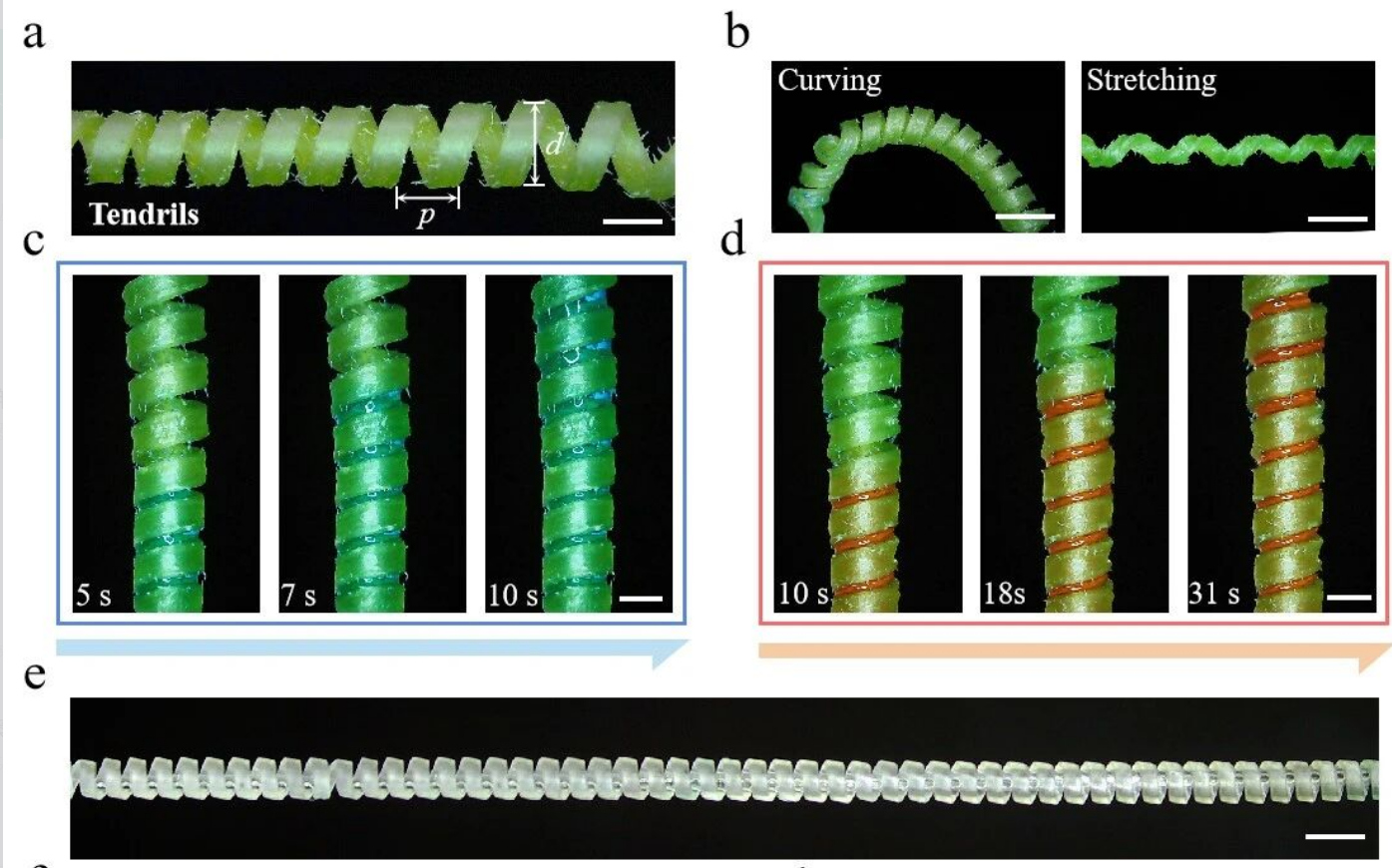
Fig. 3D-printed biomimetic spring-like microchannels in cucumber rolls
The biomimetic spring microchannels demonstrated high separation performance across different oil–water systems, with separation efficiency consistently above 99% and a maximum separation flux of 292.5 L m⁻² h⁻¹. The structure also showed the ability to capture oil–water interfaces while reducing the risk of clogging, and the approach was further demonstrated for crude-oil/water separation.
Unlike conventional separation systems that primarily depend on filtration membranes or external mechanical forces, this approach uses the geometry, wettability, and mechanical response of the microchannel itself to regulate fluid transport. The study demonstrates how biomimetic three-dimensional architectures fabricated through PμSL can evolve from passive microstructures into functional microfluidic pumps capable of selective liquid transport and separation.
From Microstructure Fabrication to Functional Fluid Control
Together, these studies demonstrate a common direction in advanced microfluidics: the geometry of a microscale structure can become a mechanism for controlling liquid behavior. Although the underlying mechanisms differ, all three approaches depend on the ability to accurately reproduce complex three-dimensional structures at the microscale.
BMF's PμSL technology enables researchers to move beyond planar channels and conventional fabrication constraints, allowing curved edges, ratchet structures, helical channels, and other three-dimensional architectures to be directly designed and fabricated. Such geometric freedom provides a foundation for developing passive fluidic systems that can route, transport, separate, or respond to liquids without relying exclusively on external actuation.