


Microneedles provide an attractive interface between the skin and wearable electronics, enabling biochemical sensing with minimal tissue disruption while supporting compact, portable device designs. However, the development of advanced microneedle sensors requires more than simply fabricating sharp needle tips. Modern wearable systems increasingly incorporate hollow channels, microtubes, multilayer electrodes, sensing interfaces, and fluidic pathways into highly compact architectures.
BMF's Projection Micro Stereolithography (PμSL) technology provides a high-resolution additive manufacturing approach for producing these complex microstructures. With optical resolution down to 2 μm across its micro 3D printing platform and 10 μm-level solutions such as the microArch® S140, BMF enables researchers to prototype and manufacture microneedles, microchannels, hollow microstructures, and other intricate components for wearable biosensing applications.
High-Precision 3D Printed Dual-Sensing Microneedles for Wearable Drug and Biomarker Monitoring
Full paper→https://doi.org/10.1038/s41467-025-61549-9
In wearable biosensors, microneedle geometry directly influences how effectively a device interfaces with the skin and accesses interstitial fluid. Needle height, tip sharpness, wall thickness, channel dimensions, and structural strength all need to be carefully balanced.
A research collaboration between Sun Yat-sen University and Technion – Israel Institute of Technology explored a new approach to this challenge by developing a wearable microneedle-based monitoring platform capable of simultaneously tracking a therapeutic drug and its associated biomarker in skin interstitial fluid.
At the heart of the system is a dual-sensing microneedle structure fabricated using BMF's microArch® S140 (Optical resolution:10μm). The high-resolution additive manufacturing process enabled the researchers to translate a highly integrated microneedle design into a functional sensing component, demonstrating the potential of micro 3D printing for next-generation wearable healthcare devices.
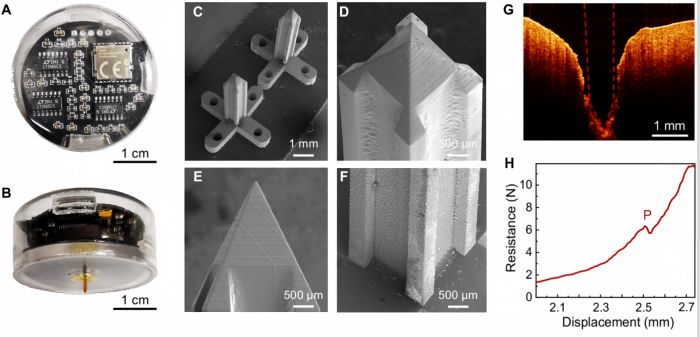
Fig. Assembly of glucose/metformin sensors
The research team therefore developed a compact wearable system designed to acquire complementary information from skin interstitial fluid. Instead of monitoring only a physiological biomarker, the system combines drug concentration sensing with biomarker monitoring, providing a more comprehensive picture of both therapeutic exposure and physiological response.
Rather than relying solely on conventional blood sampling, this type of microneedle-based interface creates a minimally invasive pathway for accessing biochemical information beneath the skin. When integrated with miniaturized electronics and wireless communication, the printed structure can become part of a wearable platform for continuous monitoring.
High-Precision Micro 3D Printing for Continuous Glucose Monitoring and Insulin Delivery
Full paper→ https://doi.org/10.1002/advs.202503536
The development of wearable artificial pancreas systems is moving diabetes management toward a more automated and responsive model. However, miniaturizing a closed-loop system into a wearable patch presents a fundamental engineering challenge. The interface between the device and the skin must simultaneously support reliable biosensing, efficient drug delivery, mechanical stability and compact integration.
A research team at Peking University addressed this challenge by developing a closed-loop bioelectronic artificial pancreas patch incorporating a 3D printed microtube array and transient dissolvable microneedles. The microtube structures were fabricated using BMF's microArch® S140, providing the high-resolution manufacturing capability required for the compact and functional architecture.
In this application, microtubes with different geometrical configurations were investigated, with heights ranging from approximately 0.6 to 2.3 mm and outer diameters from 0.6 to 1.5 mm. A compact 2x2 microtube array was also developed, with a center-to-center spacing of approximately 4 mm.
The 3D printed microtube array forms one part of a compact bioelectronic platform that combines glucose sensing, electroosmotic pumping, electronic control and wireless communication. The overall system was designed around low-power operation and miniaturized electronics, with the objective of integrating sensing and insulin delivery into a wearable form factor. Data from the sensing component can be processed by the electronic module and communicated wirelessly, enabling the system to respond to changing glucose conditions.
From a manufacturing perspective, the microtube demonstrates an important principle for wearable medical devices: miniaturization does not simply mean making an existing component smaller. It requires rethinking the architecture so that structural, fluidic and sensing functions can coexist within the same microscale component. This is where high-resolution 3D printing becomes particularly valuable.
Why Precision Matters in Microneedle-Based Sensors
The value of a microneedle is increasingly determined by what it can do beyond skin penetration. Microchannels can facilitate fluid access, hollow structures can support transport, and customized surfaces can provide locations for sensing materials or electrodes.
BMF's high-resolution micro 3D printing makes it possible to develop these structural features as part of a single microfabricated architecture, supporting more compact and multifunctional wearable systems. The microArch® S140 offers 10 μm optical precision, making it suitable for research applications requiring controlled microscale features, including microchannels, microtubes and customized microneedle structures.
For even more demanding microfabrication requirements, BMF's higher-resolution platforms can provide optical precision down to 2 μm, opening additional possibilities for miniaturized biomedical structures.