


A recent study published in Nature Biomedical Engineering (DOI: 10.1038/s41551-025-01505-6) by Prof. Zhen Gu and Prof. Jinqiang Wang's research group at Zhejiang University introduces a bioinspired breakthrough in sound decoding, a 3D-printed artificial cilia array capable of mechanically interpreting acoustic frequencies and even triggering on-demand drug release. And in this study, BMF's Projection Micro Stereolithography (PμSL) technology enabled the fabrication of microscale artificial hair bundles that mimic the natural structure and mechanics of mammalian cochlear cells.
From human hearing to mechanical sound decoding
Human auditory perception relies on the exquisite mechanical sensitivity of cochlear hair cells. These cells detect air vibrations in the 20–20,000 Hz range through stereocilia — microscopic, height-graded filaments arranged in rows atop each hair cell, converting mechanical oscillations into neural impulses.
Inspired by this biological design, the research team set out to engineer an artificial equivalent capable of decoding sound frequencies without relying on electronic circuits, power sources, or algorithms.A concept that could transform sound recognition, bioacoustic sensing, and intelligent medical systems.
Precision fabrication using BMF's PμSL micro-3D printing
To replicate the complex architecture of cochlear stereocilia, the researchers utilized BMF's microArch® S130 system, which features a 2 μm resolution based on Projection Micro Stereolithography (PμSL). This technique enabled the precise fabrication of artificial cilia arrays with diameters of approximately 100 μm and tunable aspect ratios (L/D = 30–100).
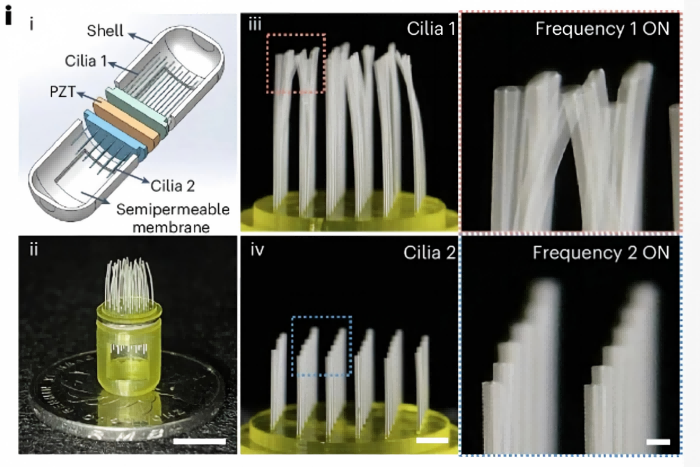
Fig.Microscale artificial hair bundles using BMF's PμSL micro-3D printing
When subjected to acoustic stimulation at 600 Hz, the printed cilia exhibited vibration trajectories that closely matched the input sound waveform. Even after more than 8 million vibration cycles, the structures maintained their integrity, demonstrating outstanding mechanical resilience and repeatability.
Mechanical sound decoding without electronics
Arrays with varying aspect ratios were designed to resonate at distinct frequencies and then integrated onto a single substrate. Each cilium selectively responded to specific acoustic frequencies — from 100 to 6000 Hz, covering much of the audible range for human voices and musical tones.
In demonstration tests, the cilia array could “decode” sound patterns from a piano piece (Twinkle, Twinkle, Little Star) and male/female speech signals purely through mechanical resonance. Each frequency component triggered corresponding cilia oscillations, effectively mapping acoustic signals without the need for power or computational algorithms — a remarkable step toward mechanical auditory devices.
Acoustic resonance and fluid dynamics in water
The team further examined the behavior of the artificial cilia in liquid environments using a piezoelectric transducer (PZT) to generate sound waves. Numerical simulations in COMSOL revealed that at resonance, localized microvortices formed near the cilia tips with flow velocities up to 0.00241 m/s.
Experimental Particle Image Velocimetry (PIV) confirmed that acoustic stimulation produced significant flow enhancement at resonant frequencies, despite energy losses during sound propagation through water. This phenomenon laid the foundation for acoustic-controlled fluid manipulation and targeted drug delivery.
Sound-triggered drug release for diabetes therapy
To explore potential biomedical applications, the team coated the artificial cilia with GelMA hydrogels encapsulating insulin and glucagon as model drugs. Under sound stimulation generated by PZT, insulin release from the hydrogel-coated cilia significantly increased compared to the unstimulated control.
Among various hydrogel formulations, GelMA-90 crosslinked for 120 seconds achieved the highest insulin release efficiency. Extended in-vitro experiments over six hours showed enhanced dual-drug (insulin and glucagon) release upon acoustic activation, demonstrating the potential of the system for non-invasive, frequency-controlled drug delivery.
Toward bioacoustic interfaces and smart healthcare
This research presents a new paradigm for sound perception and actuation — a fully passive, mechanically responsive system capable of decoding sound frequencies and mediating fluidic or biochemical responses. The artificial cilia array opens new possibilities for acoustically driven devices, personalized voice-interactive systems, and intelligent therapeutic platforms.
In the long term, such biomimetic structures could be optimized to interpret complex speech patterns or physiological sounds — such as breathing, heartbeat, or intestinal motion — providing novel diagnostic and monitoring tools.
By enabling the fabrication of microstructures that faithfully mimic biological precision, BMF's PμSL technology continues to empower interdisciplinary innovation at the intersection of microengineering, bioacoustics, and intelligent medicine.