


Keywords:cavitation-on-a-chip,liposomes,microfluidic, pharmacokinetics and pharmacodynamics,drug delivery
The research team from Central South University has successfully printed a complex microfluidic chip using ultra-high precision Projection Micro Stereolithography (PμSL) 3D printing technology, and has developed a controllable cavitation-on-a-chip (CCC) strategy. This innovation not only improves the encapsulation efficiency and size uniformity of liposomes but also provides new application potential for fields such as anti-tumor drug delivery, gene therapy, and medical imaging.
Liposomes, as one of the most promising drug carriers, play important roles in pharmacokinetics and pharmacodynamics. Because it can prolong the circulation time of drugs and reduce the toxic and side effects of drugs, it is widely used in cancer immunotherapy, gene therapy, medical imaging and other fields. Traditional bulk techniques for preparing liposomes make it difficult to directly control the particle size of liposomes. Even if the particle size can be reduced, it still has the disadvantages of time-consuming, low efficiency, and poor reproducibility. Microfluidic technology for preparing liposomes enable the particle size through the flow rate ratio of the lipid solution. However, the concentration of the liposome will be changed, which will affect the encapsulation efficiency and stability of liposomal drugs,thereby limiting the subsequent application of liposomes. To overcome these problems,there is a need to develop a method for precise particle size control of liposomes without changing the flow rate ratio.
A research team from Central South University, using BMF’s micro 3D printing technology, invented a controllable cavitation-on-a-chip (CCC) strategy , successfully printed a microfluidic chip with extremely small details and very complex structures. This method helps Precisely adjust the particle size distribution of liposome drugs without changing the flow rate ratio (FRR). This is of great significance for improving the pharmacodynamics and pharmacokinetics of liposome drugs.
The research results, titled "Cavitation-on-a-Chip Enabled Size-Specific Liposomal Drugs for Selective Pharmacokinetics and Pharmacodynamics," were published in Nano Letters. Click here to read the original text: https://doi.org/10.1021/acs.nanolett.4c02114
A high-precision microfluidic hybrid chip was prepared by BMF microArch S140 (resolution: 10 μm), which provided a device foundation for the cavitation-on-a-chip (CCC) platform. The device can synthesize liposomes without changing the flow rate ratio of the buffer and lipid solution. It has the characteristics of smaller particle size, higher encapsulation rate, and more uniform size, which is conducive to uniform drug release and stable therapeutic effect.
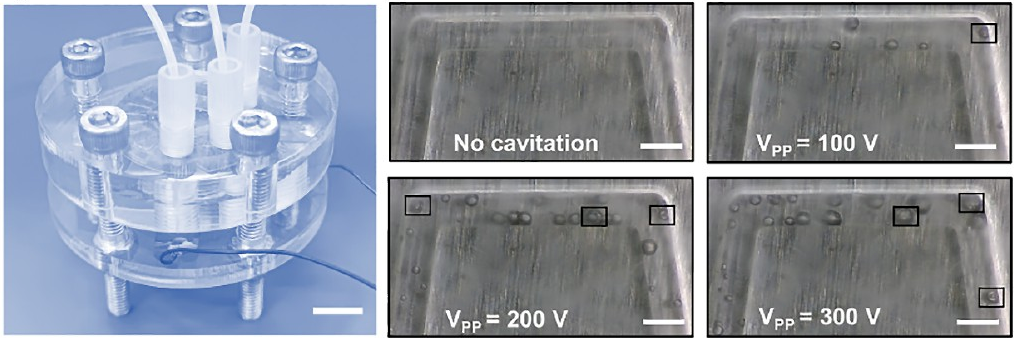
Fig. A high-precision microfluidic hybrid chip was prepared by BMF microArch S140 (resolution: 10 μm)
Application Potential in the Field of Biomedicine
· Cancer immunotherapy: Smaller liposomes have a more pronounced enrichment in tumor and kidney areas, enhancing the targeting of drugs. Liposomes with small particle size can improve the targeting of drugs,and easier to be taken up by tumor organoids, thereby effectively achieving therapeutic outcome.
· Gene Therapy and Medical Imaging: The application of microfluidic cavitation devices provides new tools and methods for gene therapy and medical imaging.
Leader in Micro 3D Printing Technology - BMF
BMF's 3D printing technology is widely used by amounts of scientific research and industrial customers for its high precision and high tolerance control capabilities, which can achieve resolutions of 2 μm /10 μm/ 25 μm, meeting the needs of micro-scale manufacturing. In the aforementioned research, PμSL technology has been used to print microfluidic chips, which are key to implementing the controllable cavitation-on-a-chip (CCC) strategy.
With the expansion of research and application innovation, micro 3D printing technology will play a more critical role in biomedicine and more other fields. If you are interested in the empowerment and application of AM technology in other fields, please contact us to start new possibilities!