


Microneedles are attracting growing interest in biomedical research, with applications ranging from biosensing and transdermal drug delivery to cell therapy and tissue regeneration. As these applications evolve, researchers are exploring increasingly sophisticated microneedle designs that integrate specialized geometries, hollow channels, micro-openings, and functional material systems.
High-precision micro 3D printing offers an alternative approach, enabling the fabrication of intricate structures and customized molds that support the development of next-generation biomedical devices. Recent research from the University of Electronic Science and Technology of China, Zhejiang University, and Nanjing University demonstrates two distinct approaches to microneedle fabrication using BMF's high-precision micro 3D printing technology. The studies highlight how PμSL techology can support both the direct fabrication of complex microneedles and the production of precision molds for functional microneedle devices.
Case Study 1: Direct 3D Printing of Barbed Microneedles for Smart Wound Management
Full paper→https://doi.org/10.1038/s41378-025-01136-6
Chronic wound management requires effective monitoring of wound conditions and timely therapeutic intervention. Microneedle-based systems offer potential for integrating these functions, but their performance depends on the geometry, mechanical stability, and functional characteristics of the needle structures.
In particular, barbed microneedles require carefully designed protrusions to improve mechanical anchoring, while hollow microneedles must incorporate internal channels for fluid transport. Integrating these features into a single structure creates additional manufacturing challenges, especially when small geometric details must be reproduced consistently.
The research team utilized BMF's microArch® S240 system (optical resolution:10μm) to directly fabricate two types of microneedles: barbed microneedle electrodes for sensing and barbed hollow microneedles for drug delivery.
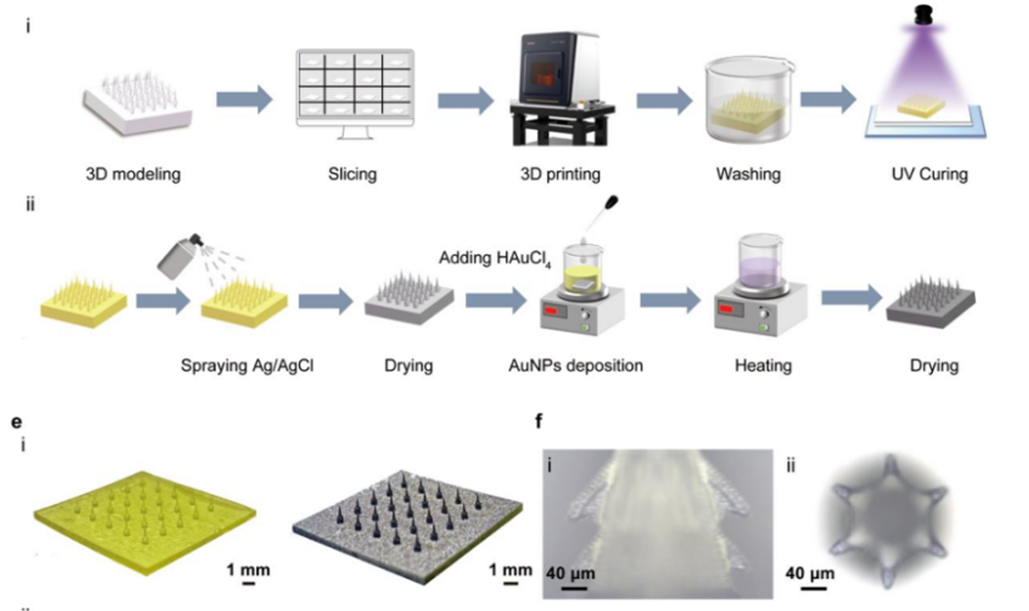
Fig.The fabrication process of 3D-BMN and 3D-BHMN
The printed sensing microneedles featured a base diameter of approximately 400 μm and a total length of 1,300 μm. Their design incorporated two layers of barbs, with six barbs per layer arranged at a 45° angle. The hollow microneedle design incorporated internal channels with a reported lumen diameter of 150 μm, while the barbed features measured approximately 50 μm.
Following printing, the sensing microneedles underwent surface modification with Ag/AgCl and gold nanoparticles to enhance their electrochemical properties. The resulting structures were incorporated into an integrated platform combining wound impedance monitoring with ultrasound-assisted drug delivery. The researchers evaluated the mechanical anchoring performance of the barbed structures and the electrochemical characteristics of the modified microneedle electrodes. The hollow microneedles were also integrated with an ultrasonic atomizer to facilitate drug delivery.
The study demonstrates how high-precision micro 3D printing can help translate complex microneedle geometries into functional biomedical prototypes, supporting the development of integrated sensing and drug-delivery systems.
Case Study 2: Precision Mold Fabrication for Electroactive Microneedle Patches
Full paper:10.1126/sciadv.aeb4840
Stem cell therapy for myocardial infarction faces challenges associated with cell retention at the target site and the ability to sustain beneficial interactions between transplanted cells and surrounding tissue.
To address these challenges, the research team developed an implantable electroactive microneedle patch designed to accommodate mesenchymal stem cells and support their interaction with injured cardiac tissue. The device incorporated a relatively large cell-loading cavity, multiple blunt microneedle tips, and micro-openings for material exchange.
Unlike conventional sharp microneedle arrays designed to penetrate the skin, this device used blunt tips to create a structure suited to its specific implantation and cell-delivery requirements. The customized geometry required a fabrication approach capable of reproducing multiple features within a compact mold assembly.
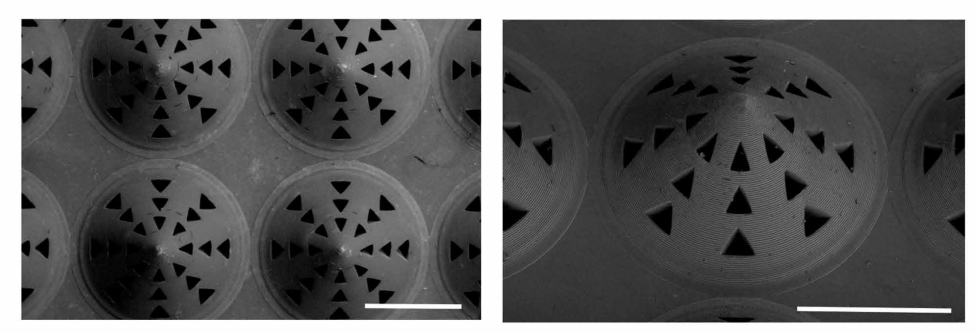
Fig.Representative scanning electron microscopy (SEM) images of the IEMP
The research team used BMF's microArch® S130(optical resolution:2μm) to fabricate precision molds from HTL photosensitive resin. These printed molds were subsequently used to produce polydimethylsiloxane (PDMS) molds, which served as tooling for forming the final microneedle device.
The resulting implantable electroactive microneedle patch was made from poly(L-lactic acid) (PLLA), a biodegradable polymer with piezoelectric properties. The device featured 12 blunt microneedle tips and a cell-loading cavity of approximately 80 mm³. Each tip incorporated 24 micro-openings to facilitate exchange between the encapsulated cells and the surrounding environment.
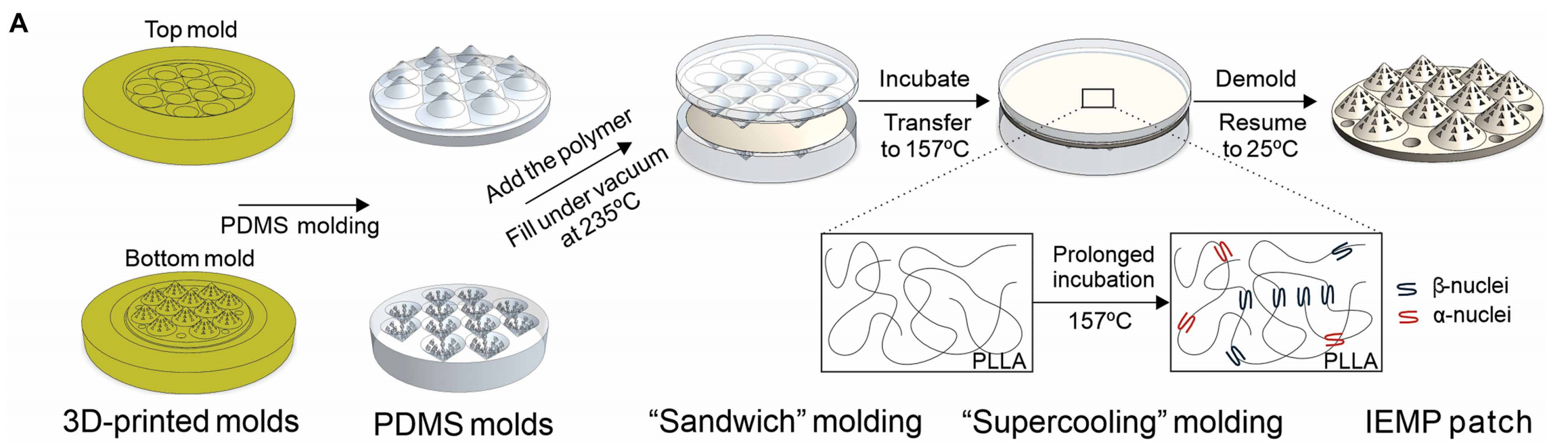
Fig.Schematic presenting the fabrication process of the IEMP patch
By enabling customized mold geometries, BMF's microArch® S130 supported the fabrication of structures that integrated a cell-loading cavity, multiple needle tips, and numerous small openings into a single device architecture. This work highlights the importance of precision mold fabrication in biomedical engineering, particularly when the final device requires complex geometries and specialized material properties that cannot be achieved through direct printing alone.
Advancing Biomedical Innovation with BMF
BMF's micro 3D printing technology provides researchers with additional manufacturing options for developing complex microneedle structures and other precision biomedical components. Through both direct printing and precision mold fabrication, the technology can support research workflows involving specialized geometries, customized prototypes, and functional microdevices.
As microneedle research continues to expand into biosensing, drug delivery, cell therapy, and regenerative medicine, high-precision micro 3D printing offers a versatile tool for exploring designs that are difficult to realize using conventional fabrication approaches.
Jion us and discover how BMF micro 3D printing can support the development of precision biomedical devices.