


Recreating the human body's physiological environment outside the body has long been one of the major goals of biomedical research. From drug discovery and toxicity testing to disease modeling and personalized medicine, researchers increasingly need in vitro models that can reproduce the structural and functional complexity of human tissues more faithfully.
Organ-on-a-chip and organoid technologies have provided important advances in this direction. However, one fundamental challenge remains difficult to overcome: vascularization.
BMF has designed and manufactured a vascularized organoid-on-a-chip featuring biomimetic microvascular networks. The platform is fabricated using the BMF microArch® S230, a high-precision micro 3D printing system with an optical resolution of 2 μm.
The capillary chip has now been applied in multiple biomedical research studies, including a biomimetic vascularized liver-on-a-chip and a vascularized organoid-on-a-chip platform for long-term, centimeter-scale organoid cultivation. Beyond structural precision, the research applications also demonstrate two important characteristics for biological research: the biocompatibility of BMF BIO resin and the ability to observe cells and biological processes under microscopy.
An Integrated Perfusion System for Organ-on-a-Chip Research
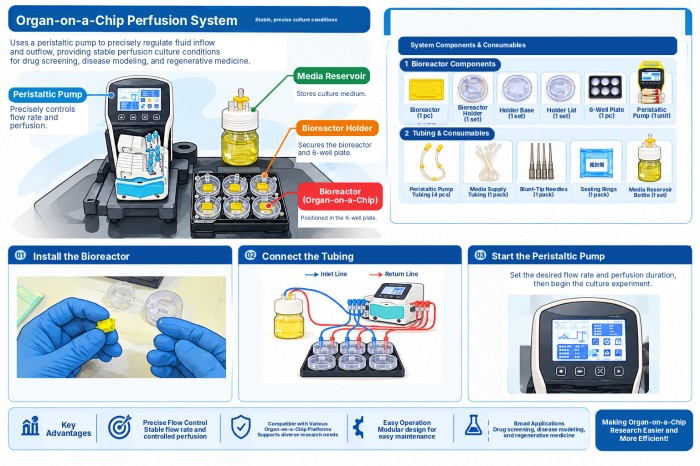
Beyond the fabrication of microfluidic chips, BMF also provides a dedicated Organ-on-a-Chip Perfusion System to support subsequent experimental procedures. The system integrates several essential components, including Bioreactor, Bioreactor Holder, Peristaltic Pump,Media Reservoir,etc.
By integrating these components, the system provides the essential fluid-handling infrastructure for organ-on-a-chip experiments, helping researchers establish continuous perfusion conditions and maintain a more consistent culture environment.
Case Study 1: A Biomimetic Vascularized Liver-on-a-Chip
Doi: https://onlinelibrary.wiley.com/doi/10.1002/smll.202505653
The liver plays a central role in drug metabolism and toxicity. As a result, reliable liver models are highly valuable for pharmaceutical development and hepatotoxicity research. Conventional two-dimensional cell culture systems remain widely used, but they cannot fully reproduce the three-dimensional architecture and dynamic physiological environment of liver tissue.
The liver contains a highly organized microvascular system. Blood flow through hepatic sinusoids continuously supports hepatocyte function while facilitating the transport of nutrients, oxygen, drugs, and metabolic products. To better reproduce this environment in vitro, a research team developed a biomimetic vascularized liver-on-a-chip platform using high-precision micro 3D printing.
The capillary structure was fabricated using the BMF microArch® S230 with 2 μm optical resolution.The structure included multiple layers of parallel microchannels. Individual artificial capillaries featured dimensions on the scale of biological microvessels, with an internal diameter of approximately 80 μm and an external diameter of approximately 120 μm.
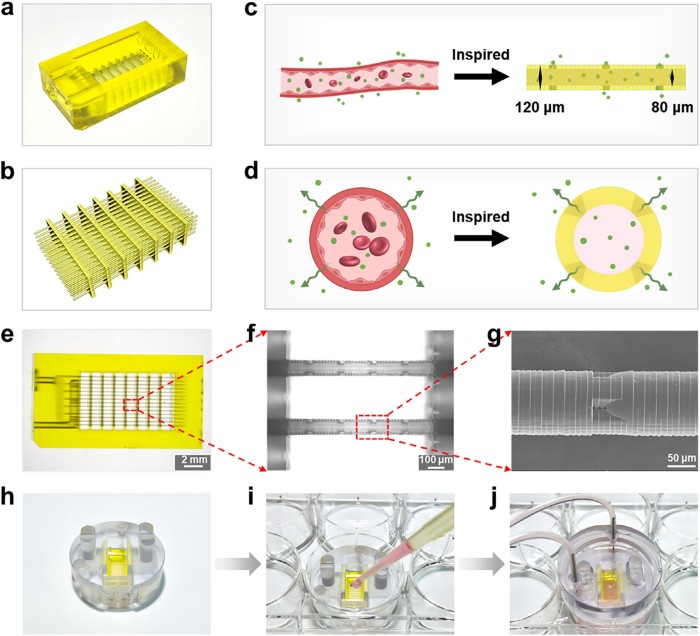
Fig. Characterization of Biomimetic Vascularized Chips
Cell culture experiments further validated the superior performance of the chip. After 7 days of culture in the 3D chip, live/dead staining of hiPSC-Heps revealed a cell viability of over 90%, whereas 2D cultures exhibited significant cell death due to contact inhibition. The case demonstrates that micro-scale structural precision is not simply a manufacturing advantage—it can directly influence the ability of researchers to create more sophisticated biological models.
Case Study 2: Capillary Chips Enable Centimeter-Scale Organoid Cultivation
Doi: https://doi.org/10.1631/bdm.2400424
Organoids are three-dimensional (3D) cell culture models that replicate key structural and functional characteristics of human organs. However, conventional organoid culture systems lack complex vascular networks, limiting the delivery of oxygen and essential nutrients to larger tissue structures. As a result, nutrient deprivation and metabolic waste accumulation often restrict organoid growth and long-term viability.
To overcome these limitations, a collaborative research team developed a vascularized organoid-on-a-chip platform for centimeter-scale organoid cultivation. The platform integrates biomimetic microvascular networks with a continuous perfusion system, enabling long-term cultivation of tumor-derived and normal tissue-derived organoids.
The fabrication of vascularized organoid-on-a-chip devices requires exceptional manufacturing precision, the research team employed BMF's microArch® S230(optical resolution:2 μm), together with BMF's BIO resin to fabricate the customized microfluidic chip. Infusion device was integrated, and the culture medium could be subsequently iniected into the chip at a rate of 2 ul/min.
The printed chip incorporates a sophisticated biomimetic vascular architecture with the following structural features, each artificial vessel has an inner diameter of 80 μm and a wall thickness of 20 μm,with 4 groups of slits, each less than 10 μm wide, are periodically distributed along the channels at 300 μm intervals.
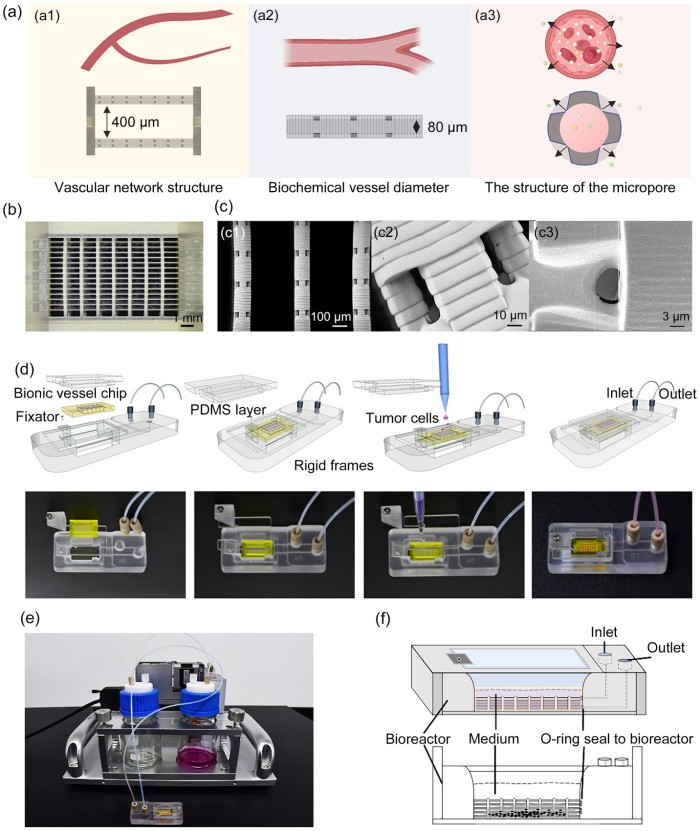
Fig. BMF micro 3D printing for the fabrication of organoid chips with blood vessels
The experiment successfully generated lung cancer organoids. Lung cancer organoids cultured using conventional methods typically cease proliferation after approximately 7 days,maintaining a diameter of around 200μm. Organoids cultured in a capillary organ-on-a-chip system exhibit higher Ki67 expression,indicating enhanced proliferative capacity. After 12 days, the organoids form tight junctions and can continue growing for over 30 days.
Combined with a continuous perfusion system, the 3D-printed vascularized chip provides sustained nutrient delivery and supports fully immersed organoid culture.
Supporting Advanced Organ-on-a-Chip Research
The integrated solution has already supported research teams in successfully carrying out important experimental work, demonstrating its practical value in organ-on-a-chip development.
To support researchers in this field, BMF's Organ-on-a-Chip Perfusion System is now commercially available. The system is designed to facilitate continuous perfusion and provide essential equipment for advanced cell culture experiments, including research involving vascularized organoids and microvascular network development.
For more information about the Organ-on-a-Chip Perfusion System, product specifications, or potential applications, please contact our team. We welcome inquiries from researchers, academic institutions, and industry partners worldwide.