


Among the essential components of microfluidic systems, nozzles play a critical role in regulating fluid delivery, controlling multiphase flows, and generating droplets with specific structures and properties. However, developing high-performance microfluidic nozzles often requires intricate three-dimensional channel geometries, precise internal structures, and reliable connections between different functional components.
BMF provides high-resolution manufacturing capabilities for these demanding applications, has supported a range of academic research projects involving advanced microfluidic nozzles, droplet generation, and micromixing. Three recent research publications demonstrate how BMF's high-precision micro 3D printing is contributing to the development of increasingly sophisticated microfluidic systems.
Case study1: 3D Microfluidic Bubble Freeze Printing
DOI: https://doi.org/10.1016/j.jmapro.2025.04.069
The controlled generation of microbubbles is essential for developing porous materials with tailored internal structures. However, producing hydrogel materials with controllable micro- and nanoscale porosity remains challenging, particularly when maintaining structural integrity throughout the fabrication process.
In this study, researchers developed an innovative 3D microfluidic bubble freeze printing (3MFP) platform by integrating a three-dimensional microfluidic chip into a specialized printing nozzle. The system combines controlled gas-liquid flow, microbubble generation, and freeze printing to fabricate porous piezoelectric hydrogels.
BMF's microArch S140(optical resolution:10 μm ) was used to manufacture the microfluidic chip integrated into the printing nozzle. Its high-resolution photopolymerization technology provides the geometric precision required to realize intricate internal channel configurations.
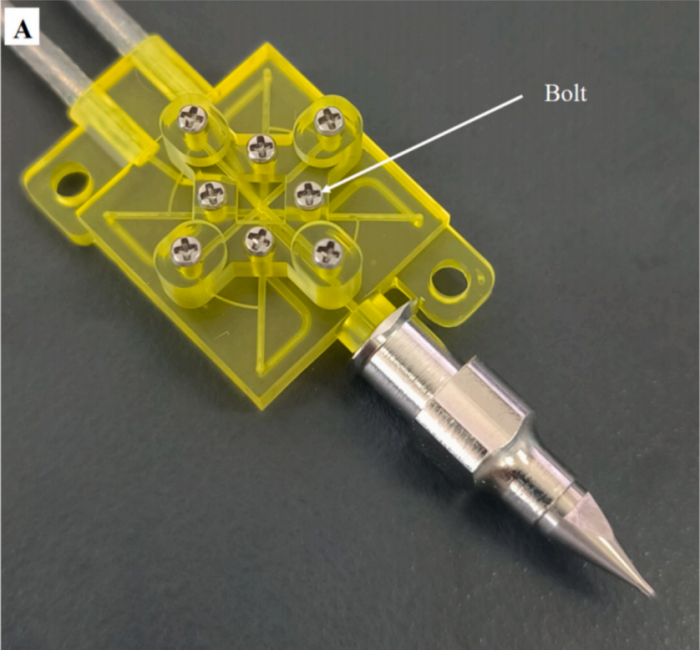
Fig. The optical image of the 3D microfluidic printing nozzle.
By enabling the fabrication of complex microfluidic structures, BMF's micro 3D printing technology supports the development of specialized nozzles that integrate fluid manipulation and material processing functions within a single component. This approach expands the design possibilities for microfluidic-assisted additive manufacturing, particularly in applications requiring controlled pore formation, multiphase fluid handling, and functional material fabrication.
Case study2: Microfluidic Templating for Milli-Capsule Fabrication
DOI: https://doi.org/10.1631/bdm.2500013
Precise droplet generation and core-shell structure control are fundamental to microfluidic encapsulation technologies. In applications involving pharmaceuticals, bioactive compounds, food, and functional materials, achieving uniform shell thickness, reliable encapsulation, and controllable release remains a significant manufacturing challenge.
In this study, researchers developed a microfluidic-templating strategy to fabricate millimeter-sized capsules with rigid, homogeneous shells for the long-term retention and controlled release of water-soluble cargoes.
The research employed a specially designed 3D-printed co-flow microfluidic device featuring two coaxial tubular channels connected to separate inlets. These channels enable the controlled combination of an aqueous inner phase and an oil-based shell phase, forming water-in-oil-in-air (W/O/A) double-emulsion droplets.
The researchers employed a high-resolution 3D-printed microfluidic device, with channel dimensions in the hundreds-of-micrometers range, to realize the integrated co-flow structure. BMF's microArch S140 (optical resolution:10μm ) was used in the fabrication of the microfluidic device.
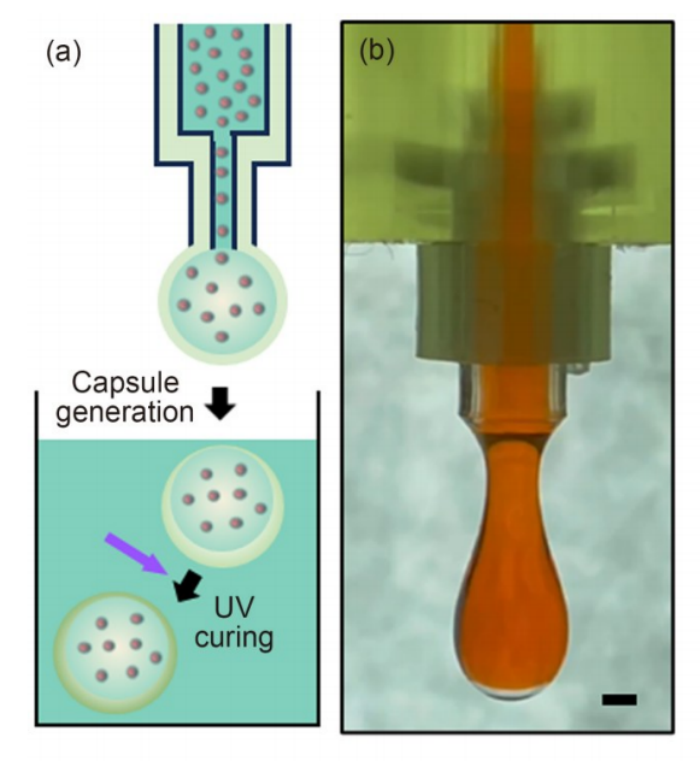
Fig. (a) Schematic of the rigid core -shell capsule production process. (b) Photograph of the water-in-oil-in-air (W/0/A) core-shell droplet production using a nested double-tube nozzl. Scale bar: 1 mm.
Case study3: Plug-and-Play Volume-Minimizing Micromixer
DOI: https://doi.org/10.1002/advs.202510268
Efficient fluid mixing is essential in microfluidic applications such as drug discovery, bioanalysis, chemical synthesis, and point-of-care diagnostics. However, conventional microfluidic mixers often face challenges in balancing mixing efficiency, internal volume, fluidic resistance, and device integration.
To address these challenges, researchers developed a plug-and-play micromixer based on a split-and-recombine (SAR) architecture. The device incorporates optimized three-dimensional curved channels that repeatedly divide, rotate, and recombine incoming fluid streams, increasing the number of fluid layers and shortening diffusion distances.
The researchers used BMF's microArch S230(optical resolution:2 μm) to fabricate the micromixer, demonstrating the feasibility of producing enclosed microchannels with dimensions as small as 60 μm.
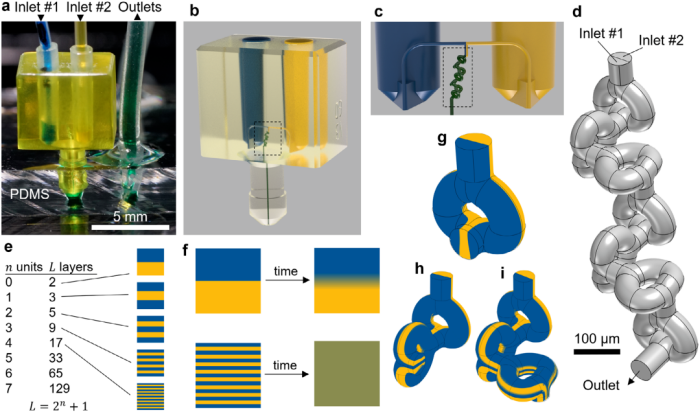
Fig.3D-printed plug-in SAR micromixer
The resulting hybrid manufacturing approach combines the geometric flexibility of 3D printing with the established advantages of soft lithography, providing researchers with additional options for developing functional microfluidic systems.
Expanding the Possibilities of Microfluidic Nozzle Manufacturing
Across these three research projects, microfluidic nozzles and related fluidic components perform different functions: generating microbubbles, producing core-shell droplets, and enabling efficient fluid mixing. Despite their different applications, they share a common manufacturing requirement: the precise fabrication of complex three-dimensional internal structures.
Through its microArch series of high-precision micro 3D printing systems, BMF provides researchers with advanced manufacturing capabilities to explore complex microfluidic geometries, accelerate device development, and translate innovative fluidic concepts into functional components.